
A procedure involving sedation and/or general anesthesia carries some risk to life, as drugs directly act on central nervous system of the patient and has secondary effect on cardiovascular and respiratory functions. These effects are unpredictable and thus doctors need to educate their clients regarding the same and make sure that risk factors are completely understood. Proof of this understanding is an “informed consent”.
Informed consent is a conversation carried out in easy language, understandable to a lay person. Medical jargon should be avoided as it is counter-productive from client’s perspective. The conversation should give sufficient information to the client to make a decision, including (1) the risks and benefits of the procedure; (2) any alternative treatment available; and (3) risks and benefits of not performing the procedure. A complication that is likely to occur more than 1% of the time is often mentioned, but certain less frequent complications may be so grave that the doctor feels it wise to mention them2.
The goal is to inform clients well enough to allow them to make right decision for their pets. Too little information fails to do so, while too much information may confuse them. It can include few commonly or usually occurring complications, instead of listing potential complications. While speaking with clients, regarding complications during an elective procedure like orchidectomy, doctor can say common complications are infection of surgical site or inflammation; mentioning death, which is a potential complication but least frequent, could be avoided. Clients expect all pertinent information to be conveyed, without misinformation about the procedure’s risks and benefits. It also dispels any unrealistic expectations clients may have from the doctor3.
Veterinary consent form has a dual role, also acting as a record of the contract for payment of veterinary services. It is recommended to mention financial estimates of the procedure as part of consent conversation and should also be documented on the consent form. (Gray, 2020). It is vital that the client signing the consent form has understood all aspects of the procedure and has cleared all their doubts. Minors, those unable to understand English and those impaired by influence of a substance are legally incapable of providing consent1.
Effective communication is the key to consent conversation. Providing proper guidance to the client to make a choice for their pets is a doctor’s duty, which should not be compromised on.
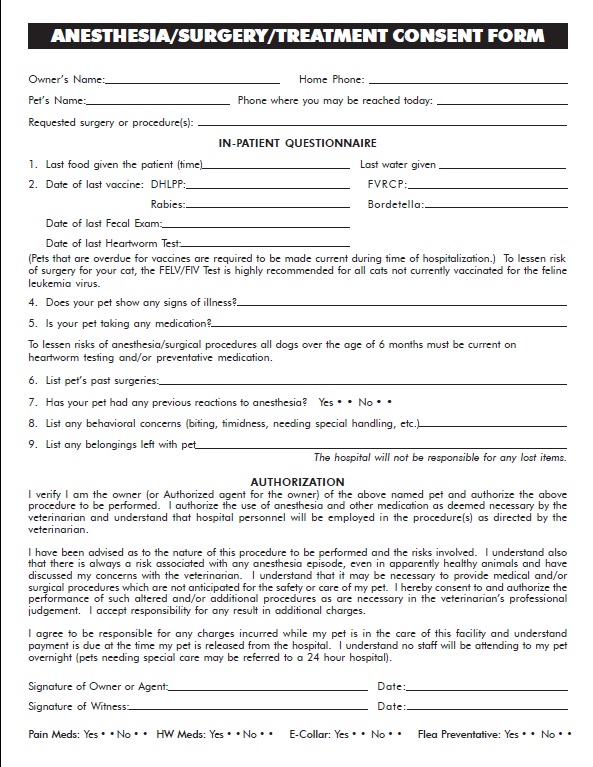
Here is an example of a form with client information and authorizations needed in a veterinary consent form:
Connect with me on LinkedIn and Instagram. Subscribe to the AnesWise newsletter for future content notifications. Kindly leave a feedback as it helps improve the blog. Feel free to ask your doubts in the comment section or email it to dr.sahilmehta@outlook.com
Editted by Prajakta Alase
Citations:
- Ackerman, L.J. ed., 2021. Pet-specific care for the veterinary team (p. 20220281482). John Wiley & Sons, Incorporated.
- Anderson, O.A. and Wearne, I.M.J., 2007. Informed consent for elective surgery—what is best practice?. Journal of the Royal Society of Medicine, 100(2), pp.97-100
- Joolaee, S., Faghanipour, S. and Hajibabaee, F., 2017. The quality of obtaining surgical informed consent: Case study in Iran. Nursing ethics, 24(2), pp.167-176.
- https://www.dvm360.com/view/anesthesia-surgery-and-treatment-consent-form




 AnesWise blog
Leave a comment