

The glamour of surgery, what you see, is built over decades of advances developed on the background scenes in and outside the operating rooms. Operating rooms (OR) are high maintenance! Positive outcomes from surgery not only rely on surgeon’s skills but also on all the other background tasks accomplished by doctors and staff in the upkeep of OR. These include ergonomics, team co-ordination, leadership, organizational culture and quality of decision- making24. These background tasks range from adjusting overhead lights, autoclaving surgery instruments, cleaning the OR, setting up the operating table, checking anesthesia machine, assigning tasks to veterinary assistants, neatly clipping fur and scrubbing surgical site, thorough cleaning OR after each procedure are few examples of important steps to be accomplished for every surgery. Errors at any point can manifest into complications during or after surgery.
Better surgical results are more likely to occur when human error is minimized. Optimizing operating room environment is challenging, but it improves patient outcomes significantly. These challenges range from easy to difficult tasks like reducing outdoor noise during surgery, maintaining OR temperature, adjusting lights and table height as per surgeon’s comfort, packing surgical instruments, sterilizing them, overcoming personal stress and fatigue. Individually these may not seem to affect the patient directly but together they have significant influence on surgical outcome.
Surgical site infection (SSI) is one of the most common complication despite prophylactic measures and use of antibiotics solely due to OR mismanagement20. Improper scrubbing of surgical site, inadequate disinfection of OR, autoclave malfunction being major factors for SSI. Using hair clippers instead of shaving with blade has shown to reduce incidence of SSI22. Ideally surgical site should be scrubbed in preparation (prep) room to avoid contaminating OR with fur and dirt. If site preparation is not possible before surgery, it can be done in the OR with care that most fur and debris is removed with vacuum cleaner.
Cleaning with chlorhexidine-alcohol is superior to cleaning the skin with povidone-iodine to prevent superficial skin infections and deep incisional infections7,8. Povidone–iodine is still used in the preparation of ocular surgery and mucous membranes, where chlorhexidine can cause damage to these delicate tissues26.
Surgeries can be classified as refined clean, clean, clean-contaminated, contaminated and dirty10.
- Refined clean surgeries are the ones which are performed in a sterile room to minimize risk of infection, like ovariohysterectomy, fracture repair, herniorrhaphy and total hip replacement.
- Surgeries performed in a non-contaminated room at a non-inflamed and non-traumatic surgical site are classed as clean surgeries (skin biopsy, percutaneous FNAC).
- Clean contaminated procedures involve entering the respiratory (nasal sinus biopsy), gastrointestinal (endoscopic foreign body retrieval, gastrotomy, enterotomy) or genitourinary system (cystotomy), where the area of surgical interest cannot be sterilized or disinfected.
- Contaminated and dirty surgeries like wound debridement and abscess lancing are preferably performed outside the OR with safe anesthesia practices.
How to design an OR?
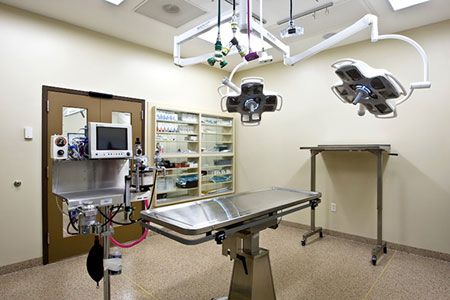
Ideal theatre should be properly lit, with minimum furniture, sleek smooth walls and non-slip antistatic floors. The table and lights should be made of stainless steel. Material of all the equipment should be easy to clean. Important characteristics of good illumination include strong light, intense area of illumination in the centre, good focus, parallel beams, shadowless, easy manoeuvrability, shielding to prevent glare, and heat reduction (with heat-filtering glass).
Preparing OR for surgery and cleaning post procedure has always been an important part of the job for veterinary assistants. There should be as little furniture in the OR as possible. A table, an instrument trolley, lights and an anaesthetic machine are the basic requirements. Occasionally specialized equipment is necessary. Stools can be provided for the staff to sit on during long surgeries.
Etiquettes
The number of staff working in OR during a procedure should be kept to an absolute minimum; lead surgeon, assistant surgeon(s), anesthetist and two veterinary assistants. Unnecessary entry and exit of staff increases the risk of fomite borne infection. Using surgical facemasks has not been shown to prevent SSI in human or veterinary science; however, their use is common and may prevent infection from the patient to operating team2,23. Everyone entering OR must wear a surgical cap and OR footwear/ shoe cover to prevent debris contaminating surgical site. Scrub set meant to be worn in OR should not be used outside the practice, to reduce incidence of fomite borne infections. Fingernails should be short, avoid wearing full sleeve shirts which can contaminate the site19, and no jewellery. The most common mode of transmission of pathogens is via hands and good hand hygiene is the most important factor in reducing nosocomial infections within hospitals. NO food or drink should EVER be consumed in the OR.
Distractions disturb!
A high frequency of distractions and interruptions occur in OR and they can affect surgeon’s concentration. The inconsequential background conversations (small talk) may help reduce stress and tensions of the operating team but may also be more distracting than quieter, non-discernible noise for a surgical team9. Stress can facilitate performance by enhancing alertness, concentration, focus and efficiency of action as long as the stress level does not exceed coping skills. High levels of stress can impair technical skills and non-technical skills such as judgment, decision-making and communication24. An interesting study was performed in 2003, where surgeons were asked to perform a laparoscopic surgery in five situations; 1. Under quiet conditions, 2. Were asked to solve a mathematical problem verbally during surgery, 3. With background noise of 80-85 dB, 4. To perform the procedure as fast as possible, 5. Combination of all three distractions. Most errors were encountered when surgeons were exposed to combined situation of performing surgery as fast as possible, solve the math problem verbally with background noise of 85dB18. Regular experienced nursing scrub staff and assistant should reduce stress levels and result in better co-ordination for the procedure. Another study found a higher complication rate in a cataract theatre when there was unplanned leave and replacement of regular staff by temporary staff3.
OR rules and why not to break them!
Surgical gowns help prevent transmission of pathogens between the patient and surgeon(s). These are available in two categories- disposable/non-woven (synthetic fabric) and woven (mostly cotton and polyester) gowns. These gowns should have liquid repellent properties. One study indicated that four out of five non-woven fabrics from disposable gowns were effective barriers against the transmission of bacteria in a laboratory setting, but all three woven fabrics from reusable gowns allowed some transmission of bacteria15. Surgical gowns should be worn for one procedure only and either disposed of or laundered daily. Laundering has also been shown to reduce the ability of fabric of reusable gowns to prevent transmission of bacteria in an in vitro setting16. Surgeons sweat less with disposable gowns and reusable cotton gowns are (subjectively) warmer than non-woven gowns.
The temperature of OR is often determined by anaesthetist, with due consideration to the needs of patient, balanced against his/her own comfort as well as that of operating team. Maintaining normothermia for the patient is of paramount importance for many reasons. Prospective randomized trials have demonstrated a relationship between hypothermia and increased intraoperative blood loss, cardiac events and SSI4,14.
Surgical posture is the way in which surgeon(s) position their body during surgery for ergonomic comfort. Poor posture affects psychomotor performance leading to muscle fatigue5,17. Studies have indicated that general surgeons experience substantial stress to their shoulders, neck and back with their postures during surgery4,13. Standing with weight shared equally on both legs (shoulder length apart) is an ideal standing position for long hours. Shifting body weight on either hip changes body dynamics and is compensated by spinal movement. Working height of the operating table has different impact on individual muscle load. A study found that trapezius muscle tension increased above recommended threshold level while standing when the table height was over 5cm above the elbow1.
It is important that equipment is cleaned first, then either disinfected or sterilized appropriately prior to being stored correctly. Pseudomonas aeruginosa is a common opportunistic microbe which can be transmitted from patient to patient if anaesthetic equipment is not disinfected regularly12. SSI incidents should be notified and recorded to monitor if the preventative measures are working. A sudden increase in incidence of SSI will indicate if there is a problem with adherence to protocol or a fault in the process of sterilization which may otherwise have gone undetected. Principle behind infection control in the OR is to limit contamination of surgical site with microorganisms from the practice. Best way to avoid any problems with theatre hygiene is to devise a good cleaning system and routine. Write it down and place it where operating team can read it and then make sure that everyone complies with it. A good routine will take time but it is vitally important that we always strive to provide the best possible facilities and hygiene for patients under our care.
The presence of trainees, either as lead surgeon or assistant surgeon will also have an impact on surgical procedures. Studies have shown that trainees during major operations do not compromise a good outcome, even if they are the primary surgeon as long as they are supervised11,21. Trainee participation enhances their surgical training. On the other hand, trainee surgeons take longer to perform operations and this may increase stress levels by the need to complete a surgery within an allotted time period.
OR is a complex system. Optimizing the operating environment to make surgeon more comfortable will improve safety and quality. Certain environmental factors can be controlled. Some stressors such as noise, outside influences and interruptions can be reduced by altering operating room practices. Maintaining the same operating team, more thoughtful scheduling/planning of cases and better preparation with a good night’s rest are some of the methods that can be used to improve outcomes. More emphasis and consideration should be placed on posture and other ergonomic factors. By enhancing these factors, not only may surgical outcomes be improved but also give satisfaction with the surgical workplace.
Edited by Prajakta Alase
Citations:
- BENDIX, T., KROHN, L., JESSEN, F. and AARÅS, A., 1985. Trunk posture and trapezius muscle load while working in standing, supported standing, and sitting positions. Spine, 10(5), pp.433-439.
- Bahli, Z.M., 2009. Does evidence based medicine support the effectiveness of surgical facemasks in preventing postoperative wound infections in elective surgery. J Ayub Med Coll Abbottabad, 21(2), pp.166-169.
- Baylis, O.J., Adams, W.E., Allen, D. and Fraser, S.G., 2006. Do variations in the theatre team have an impact on the incidence of complications?. BMC ophthalmology, 6, pp.1-5.
- Berguer, R., 1999. Surgery and ergonomics. Archives of surgery, 134(9), pp.1011-1016.
- Bhatnager, V.D.C.G., Drury, C.G. and Schiro, S.G., 1985. Posture, postural discomfort, and performance. Human factors, 27(2), pp.189-199.
- Bräuer, A. and Quintel, M., 2009. Forced-air warming: technology, physical background and practical aspects. Current Opinion in Anesthesiology, 22(6), pp.769-774.
- Chaiyakunapruk, N., Veenstra, D.L., Lipsky, B.A. and Saint, S., 2002. Chlorhexidine compared with povidone-iodine solution for vascular catheter–site care: a meta-analysis. Annals of internal medicine, 136(11), pp.792-801.
- Darouiche, R.O., Wall Jr, M.J., Itani, K.M., Otterson, M.F., Webb, A.L., Carrick, M.M., Miller, H.J., Awad, S.S., Crosby, C.T., Mosier, M.C. and AlSharif, A., 2010. Chlorhexidine–alcohol versus povidone–iodine for surgical-site antisepsis. New England Journal of Medicine, 362(1), pp.18-26.
- Hodge, B. and Thompson, J.F., 1990. Noise pollution in the operating theatre. The Lancet, 335(8694), pp.891-894.
- Hotston, A., 1995. Rational perioperative antibacterial therapy. In Practice, 17(4), pp.166-171.
- Hutter, M.M., Glasgow, R.E. and Mulvihill, S.J., 2000. Does the participation of a surgical trainee adversely impact patient outcomes? A study of major pancreatic resections in California. Surgery, 128(2), pp.286-292.
- Ichikawa, T., 2010. Disinfection and sterilization of the devices in operating theatres. Masui. The Japanese Journal of Anesthesiology, 59(5), pp.571-576.
- Kant, I. J., L. C. G. M. de Jong, M. van Rijssen-Moll, and P. J. A. Borm. “A survey of static and dynamic work postures of operating room staff.” International archives of occupational and environmental health 63 (1992): 423-428.
- Kurz, A., Sessler, D.I. and Lenhardt, R., 1996. Perioperative normothermia to reduce the incidence of surgical-wound infection and shorten hospitalization. New England Journal of Medicine, 334(19), pp.1209-1216.
- Leonas, K.K. and Jinkins, R.S., 1997. The relationship of selected fabric characteristics and the barrier effectiveness of surgical gown fabrics. American Journal of Infection Control, 25(1), pp.16-23.
- Leonas, K.K., 1998. Effect of laundering on the barrier properties of reusable surgical gown fabrics. American journal of infection control, 26(5), pp.495-501.
- Liao, M.H. and Drury, C.G., 2000. Posture, discomfort and performance in a VDT task. Ergonomics, 43(3), pp.345-359.
- Moorthy, K., Munz, Y., Dosis, A., Bann, S. and Darzi, A., 2003. The effect of stress-inducing conditions on the performance of a laparoscopic task. Surgical Endoscopy and Other Interventional Techniques, 17, pp.1481-1484.
- Napolitano, L.M., 2006. Decolonization of the skin of the patient and surgeon. Surgical Infections, 7(Supplement 3), pp.s-3.
- Packer, M. and Devaney, J., 2010. How to manage infection control in the operating theatre. The Veterinary Nurse, 1(2), pp.115-118.
- Paisley, A.M., Madhavan, K.K., Paterson-Brown, S., Praseedom, R.K. and Garden, O.J., 1999. Role of the surgical trainee in upper gastrointestinal resectional surgery. Annals of the Royal College of Surgeons of England, 81(1), p.40.
- Tanner, J. and Melen, K., 2021. Preoperative hair removal to reduce surgical site infection. Cochrane database of systematic reviews, (8).
- Webster, J., Croger, S., Lister, C., Doidge, M., Terry, M.J. and Jones, I., 2010. Use of face masks by non‐scrubbed operating room staff: a randomized controlled trial. ANZ journal of surgery, 80(3), pp.169-173.
- Wetzel, C.M., Kneebone, R.L., Woloshynowych, M., Nestel, D., Moorthy, K., Kidd, J. and Darzi, A., 2006. The effects of stress on surgical performance. The American Journal of Surgery, 191(1), pp.5-10.
- Wong, S.W., Smith, R. and Crowe, P., 2010. Optimizing the operating theatre environment. ANZ journal of surgery, 80(12), pp.917-924.
- Wu, P.C., Li, M., Chang, S.J., Teng, M.C., Yow, S.G., Shin, S.J. and Kuo, H.K., 2006. Risk of endophthalmitis after cataract surgery using different protocols for povidone–iodine preoperative disinfection. Journal of Ocular Pharmacology & Therapeutics, 22(1), pp.54-61.


 AnesWise blog
Leave a comment